
Swartland in white: the eleven voices of Palladius
25 October 2026 · sommelier.vi.cat
Imagine asking about a white wine and being told: “It contains eleven varieties.” You might wonder whether someone has lost the recipe, or is trying to say something rather precise with a lot of moving parts. Palladius 2016 invites us to explore the second possibility. To understand it, it is worth stepping away from the list of aromas and looking at how a Swartland wine is put together.
You do not need to memorise a grape line-up. Understanding what a blend can contribute, and why a producer chooses clay, concrete or wood, is rather more useful. A glass should start a conversation, not an entrance exam.
Swartland on the map
Swartland lies north of Cape Town, in South Africa’s Western Cape. Malmesbury is a useful reference point; Paardeberg, Riebeek Kasteel and Piketberg help locate the landscape discussed here.
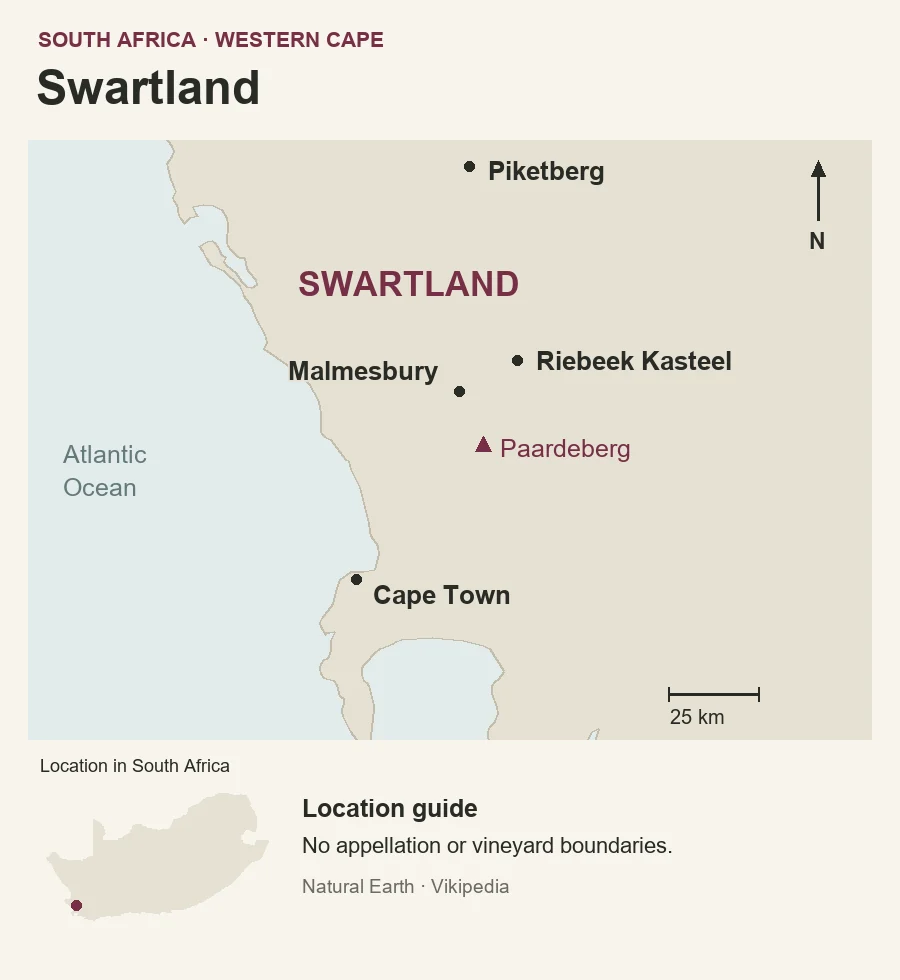
The markers show reference locations, not the vineyards behind this bottle. Map sources: Swartland Wine & Olive Route · Natural Earth.
A region with more than one possible reading
Swartland lies north of Cape Town, in South Africa’s Western Cape. Malmesbury helps us get our bearings, with landmarks such as Paardeberg and Kasteelberg nearby. The regional wine route’s geological map shows granite, shale-based materials and sandstone: enough diversity to question any explanation that settles everything with “the soil of Swartland”.
That map provides orientation; it does not taste for us. A geological formation is not an aroma recipe. Relating it to a particular vineyard also requires information about soil depth, water availability, exposure and the grower’s work. Relating it to a bottle requires knowing which grapes actually went into it. The winery’s postal address cannot answer that question on its own.
Our general Swartland guide introduces the landscape and its styles through Secateurs. Here we take a different approach: a region can also be interpreted by selecting and combining components. A single-vineyard wine and a blend can ask different questions about the same place. Understanding which question each is trying to answer is the interesting part.
Blending means making decisions
Blending means combining wines or batches. It need not involve different varieties: lots of the same grape, made or matured separately, can also be brought together. The point is not to collect names for a label, but to observe how the components work together. One that seems too broad on its own may find balance alongside something fresher; an especially expressive component may benefit from a partner that brings the whole into focus.
This does not make every blend a success. Adding ingredients does not guarantee a good meal, and filling a room with opinionated people does not guarantee a better conversation. You taste, compare and decide. Sometimes a combination improves balance; sometimes it obscures what made one part interesting. The variety count measures components, not quality points.
For the reader, there is a practical consequence: searching for a single star grape may be the wrong way to listen to a wine conceived as a whole. We can ask about its tension, breadth or persistence without trying to guess which exact percentage produced every sensation.
The specific timetable for Palladius 2016
The official 2018 release notes document eleven varieties: a first year ageing in clay amphorae and concrete eggs, followed by another year with the final blend in large oak casks.
The sequence is worth noticing. These are not three materials piled together as a selling point: there is one stage, followed by another with the finished blend. This lets us discuss the process without inventing grape percentages, vineyards or wood specifications absent from the document. Missing information does not improve when supplied with enormous confidence.
A concrete egg does not hatch wine
The name describes the vessel’s shape. Nor does an amphora become interesting simply because it looks good on a winery tour. Material, geometry, capacity and lining are different variables. Changing one does not mean changing them all, or promising the same result in every wine.
Experimental evidence helps keep expectations in proportion. A 2021 Sauvignon Blanc study compared steel, concrete, polyethylene and clay, with three replicates per type. It found limited chemical differences: grapes and winemaking mattered more than the vessel. It did not study Palladius or establish that one material always makes better wine.
This distinction is worth keeping: “does not add oak flavour” does not mean “has no influence”. Nor does it let us attribute every saline impression to a concrete wall. A tool can affect a process without becoming a universal explanation for everything we smell and taste.
Oak can join the table without taking it over
In everyday wine language, “oaked” often suggests vanilla, toast or spice. These are understandable associations: oak can contribute aromatic compounds, and toasting forms part of its preparation, as WSET explains. Aroma, however, is not the full extent of its role as a maturation vessel.
Size, previous use, time and handling also matter. If a vessel is enlarged proportionally, its volume grows faster than its surface area: there is less wall per litre. This helps explain why “a year in oak” leaves so much information out. It does not, on its own, describe the aromatic intensity we will encounter later.
Used wood generally contributes less oak flavour than new wood, but that general principle does not allow us to assign an age to this vintage’s casks. The same applies to their exact capacity. We can explain the mechanism without manufacturing a technical sheet. At the table, that precision is usually more useful than reciting three convincing figures, one of them invented.
From the explanation back to the glass
My tasting of Palladius 2016 brings wax, honey, saffron and ripe fruit; on the palate, volume, silky texture and vibrant acidity, with a long, saline, mineral finish. That is the experience of this bottle in 2026. There is no need to assign an aroma to every grape, or an adjective to every vessel, to describe it clearly.
Volume and freshness can coexist: one concerns how the wine fills the mouth, the other the liveliness we perceive. An impression of honey is not enough to conclude that a wine is sweet either. Separating aroma, texture and taste makes a tasting easier to understand than using “powerful” to explain absolutely everything.
Next time a wine list offers a white blend, try changing the question. Alongside “which grapes are in it?”, ask “what are they trying to do together?”. Then let the glass answer. And if eleven are taking part, at least nobody here needs to raise a hand before speaking.
Public sources: The Sadie Family, 2018 release notes, p. 2; Swartland Wine and Olive Route, geological map with no visible editorial date; Gil i Cortiella and colleagues, Molecules 26(3), 554, 21 January 2021; WSET, 27 July 2021. Links accompany the relevant facts. Reviewed on 21 October 2026. Personal tasting and editorial explanations are distinguished from vintage-specific technical information.
Wine comes from somewhere
Wines from this region, glass by glass
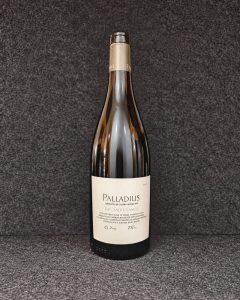
Palladius 2016: eleven varieties, no hurry
My tasting of Palladius 2016: wax, honey and saffron, with Swartland context and the decisions behind the blend.
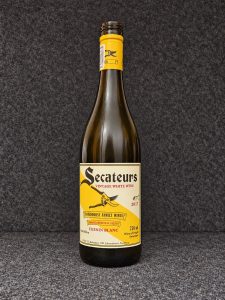
Secateurs Chenin Blanc 2017
Chenin blanc from Swartland: green apple, apricot and honey. The scissors are on the label; the tasting note needs no ornamental pruning.