Swartland: start with a glass, then open the map
18 October 2026 · Vikipedia
You order a Chenin Blanc and Swartland appears on the label. You can nod confidently. You can also ask where it is. The second option usually teaches you more and, fortunately, does not require handing back the glass.
If you arrived through Secateurs, you already have one bottle as a reference. Now let’s open the map: the region is considerably bigger than that label and deserves a few minutes.
Getting our bearings
Swartland lies north of Cape Town in southwestern South Africa. Malmesbury is a useful reference point, while names such as Paardeberg and Riebeek bring us closer to different areas. This is neither one farm nor an identical landscape from end to end.
Picture an agricultural region with cereal fields, vineyards and hills breaking up the plains. That contrast matters: a hillside vineyard and one on flatter ground need not experience the same growing season in the same way. “From Swartland” starts the conversation; we can still ask which part.
Heat, bush vines and practical decisions
Hot summers make protecting the fruit important. Bush vines are common: low, branching plants whose foliage can shade the grapes. Instead of a neatly combed wall of vegetation along wires, imagine small plants with their own canopy. Vineyard appearances have practical explanations too; not everything is arranged for the photograph.
Dry farming, practised in the region, means relying on rainfall rather than irrigation. It does not mean leaving the vine to look after itself. Growers still make decisions, and water availability matters. Old vines do not automatically guarantee an extraordinary bottle either. Age deserves respect, but cannot replace the work.
Chenin Blanc, Syrah and different approaches
Chenin Blanc and Syrah, also called Shiraz, are useful starting points for exploring Swartland. One leads us into whites, the other into reds. They are neither a complete catalogue nor a contract requiring every producer to work alike.
Comparing bottles becomes more interesting when we ask about vineyard, vintage and winemaking rather than hunt for a compulsory regional aroma. Freshness, body, fruit and texture can be discussed without making dinner a vocabulary competition. Anyone using “telluric tension” should at least explain what they tasted.
Paardeberg: our first stop with Secateurs
Badenhorst’s current description locates Secateurs Chenin Blanc on the northern side of Paardeberg, with old, rain-fed vines on granite soils. That gives us a more precise reference. Since this is not a technical sheet specifically for 2017, we do not assign exact plots to the vintage featured here.
Soil matters for growing grapes, but is not a sachet of flavour tipped into the wine. The Secateurs profile separates my impressions of that bottle from the winery’s information.
The next Swartland glass may confirm some ideas and challenge others. That is the interesting part: building the map through particular wines, rather than expecting every bottle to resemble the first.
Sources and further reading
- Swartland Wine & Olive Route · mapa
- WOSA · Wine tourism guide
- Swartland Municipality · 2026
- A. A. Badenhorst · Secateurs
Regional context expanded on 18 October 2026. General regional information does not replace the details of each wine and vintage.
Wine comes from somewhere
Wines from this region, glass by glass
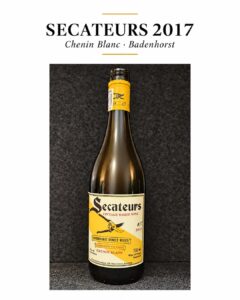
Secateurs Chenin Blanc 2017
Chenin blanc from Swartland: green apple, apricot and honey. The scissors are on the label; the tasting note needs no ornamental pruning.