
Riudebitlles: finding Penedès in a single vineyard
28 October 2026 · sommelier.vi.cat
Someone spots “Penedès” on a wine list and says, “Ah, cava.” It is not an absurd connection, just an incomplete one. Rather like assuming everybody in Barcelona earns a living photographing a basilica. With Pardas Aspriu 2019, we are setting the bubbles aside for a moment and heading into the Riudebitlles valley: a useful place to understand why a white xarel·lo may need a more precise map than its appellation alone.
Penedès · Torrelavit on the map
Torrelavit, in Alt Penedès, provides a reference point for Pardas and the Riudebitlles valley. The map locates towns; it does not outline Can Comas or the La Lola vineyard.
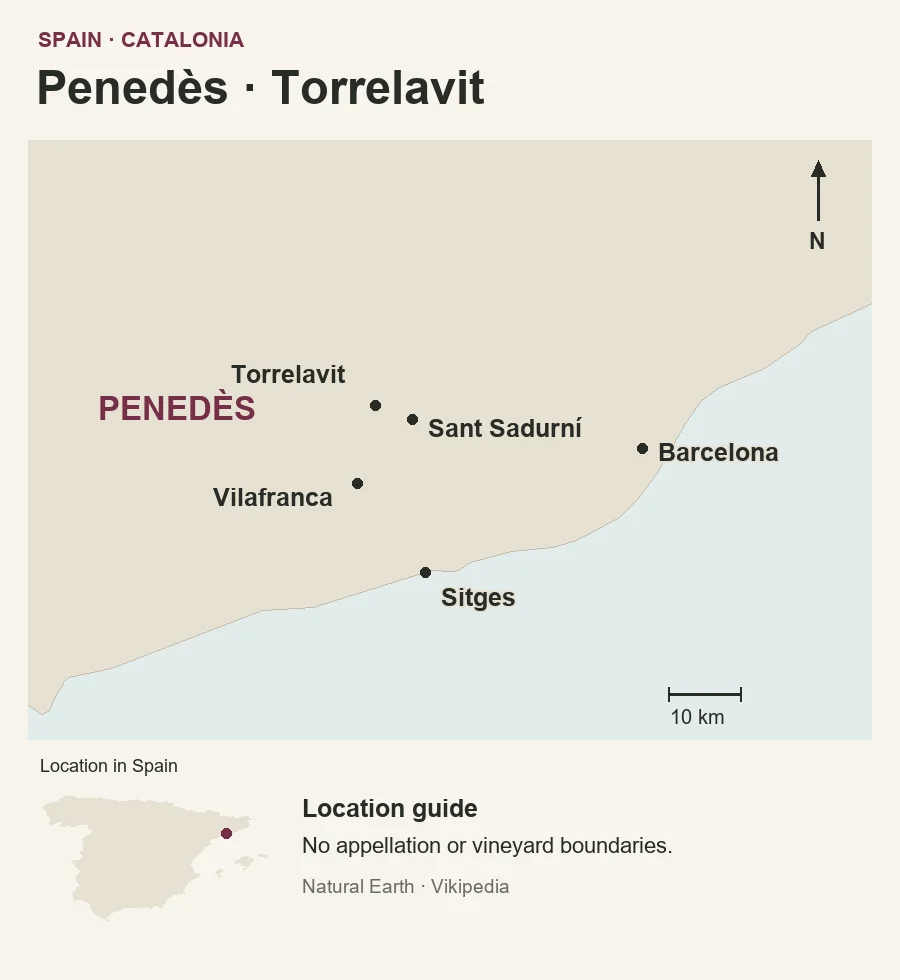
Markers show reference towns, not vineyards. Sources: Celler Pardas · Natural Earth.
Before the glass, there is a valley
Penedès does not have one landscape or a single temperature shared by every vine. Conditions vary between coastal proximity, inland areas and higher elevations. That diversity helps explain the coexistence of different wine styles. The word on the label locates an origin; it has not yet described the vineyard that produced the grapes.
The Riudebitlles takes us towards Torrelavit and a landscape in which vines share space with woodland and other crops. Can Comas, the Pardas estate, belongs to that patchwork. To picture it, think of parcels separated by changes in terrain rather than a carpet of perfectly identical vines. Wine does not grow inside a desktop wallpaper.
A valley also shapes human activity. Torrelavit’s municipal history records the importance of agriculture and mills, and places the growth of riverside papermaking in the eighteenth century. Vines and paper coexisted. That detail broadens the picture: water could have an industrial role beside the river while a dry-farmed vineyard depended on rainfall for cultivation.
From a region’s name to a vineyard’s name
Pardas grew from the project Ramon Parera and Jordi Arnan began at Can Comas in 1996. To follow their white Aspriu, we need to zoom in again and reach La Lola. This is the parcel identified by the producer, not a location inferred because the winery has an attractive address in the village.
The distinction may seem small, but it changes what we can say. A winery’s premises, the origin of its grapes and the appellation covering a wine are connected facts, not interchangeable ones. A label can be precise or leave questions open. Here we have an identified vineyard and information for the 2019 harvest, allowing us to separate place from that year’s winemaking decisions.
It is also worth distinguishing the white Aspriu from the red bearing the same name. We are following the xarel·lo from Vinya La Lola. Change the bottle and the explanation must change too. Knowing a brand does not entitle us to give every member of the family the same biography.
Xarel·lo steps beyond the conversation about bubbles
Xarel·lo is a white variety closely associated with Penedès and well known for its role in sparkling wines. It is not obliged to spend its entire life with bubbles. In a still white, we can study it on its own terms: the impression of acidity, its weight on the palate, its response to air and how any maturation fits into the whole.
Those are tasting questions, not ready-made answers. A grape variety does not carry an identical miniature aroma catalogue in every bunch. Harvest conditions, ripeness, vineyard management and cellar decisions all modify its expression. Knowing the grape helps us begin observing; it does not write the conclusion before the bottle is opened.
Here is a practical approach for a beginner: comparing two xarel·los made differently can teach more than trying to memorise twenty descriptors. Change only a few things at a time and ask what differences you actually notice. If one feels broader on the palate, that is worth exploring. There is no need to find an exotic fruit whose photograph you have just looked up on your phone.
Limestone, depth and water: soil without supernatural powers
Pardas distinguishes valley bottoms with alluvial deposits from slopes containing hardened calcareous horizons. La Lola includes the latter. A horizon is a soil layer; “petrocalcic” indicates a sufficiently cemented accumulation of carbonates. The word sounds like a film villain’s surname, but here it helps explain the ground.
For a vine, the relevant questions include how much soil its roots can explore, how water moves and how long it remains available. Nearby sites can differ meaningfully in depth, texture and structure. Saying “limestone” does not explain everything: the same term can conceal different physical situations and mixtures with other materials.
We should pause before making the familiar leap from “calcareous soil” to “the glass tastes of stone”. Soil characteristics affect the plant’s life; a sensation described as mineral does not demonstrate that we are directly tasting the rock. Comparisons can help us discuss wine, but a sensory analogy and an explanation of vine growing do different jobs.
Dry farming and aspect: choices with consequences
Dry farming relies on precipitation rather than routine irrigation. In a Mediterranean setting with irregular rainfall, management requires attention to soil reserves and the plant’s needs. Drought does not improve wine by decree. Excessive shortage can limit vine activity; turning every difficulty into a virtue is convenient for a brochure, less so for the person working the land.
La Lola’s southern aspect provides another piece of information. Exposure affects incoming radiation, although its effects also depend on slope, season, vegetation and actual weather. A compass alone cannot tell us the temperature of the grapes in September 2019. The fact helps frame an informed question; it does not invent a weather station.
Pardas describes allowing spontaneous vegetation cover when conditions permit. These are plants between the vine rows, and their management must also account for available water. The phrase “when conditions permit” matters. Working with a place requires adjustment, rather than repeating a practice because it looks good during a vineyard visit.
Back to Aspriu
The 2019 information records fermentation in used barrels and a subsequent tank phase. That precision avoids applying another harvest’s method to this wine. Used wood can play a role without obliging us to announce an intense oak aroma in advance. Knowing the vessel is not equivalent to having tasted the bottle.
At the table, the approach is simple: pour, allow time and observe. In the wine profile, my impression combines ripe fruit, honeyed notes and richness supported by acidity. That tasting is kept separate from the producer’s factual information. We can now locate the glass in a valley, a vineyard and a harvest. Next time “Penedès” appears on a list, perhaps the question will be “which part?”. A small question can open a rather good conversation.
Public sources consulted on 21 October 2026: Pardas, the project’s beginnings; estate and viticulture; Aspriu 2019; Torrelavit council, local history. Regional context checked against study references. Sensory impressions confirmed by sommelier.vi.cat.
Wine comes from somewhere
Wines from this region, glass by glass
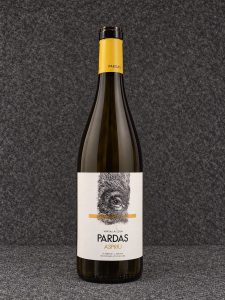
Pardas Aspriu 2019: xarel·lo takes its time
My tasting of Vinya La Lola’s xarel·lo, its Riudebitlles valley origin and the production details specific to 2019.