
Costers del Segre: seven zones and a white to find your way
4 November 2026 · sommelier.vi.cat
A white wine from Lleida can prompt two quick responses: “It gets hot there” and “Chardonnay?”. Both deserve a slightly longer conversation. Finca La Serra del Vent 2025 provides an entry point into Costers del Segre, an appellation better understood as a collection of places than as one landscape. The map has more twists than some tasting speeches.
Costers del Segre · El Vilosell on the map
El Vilosell lies in Les Garrigues, south-east of Lleida, and provides the local reference for these Tomàs Cusiné wines. Costers del Segre covers other areas too: this close-up shows neither its full boundaries nor exact vineyard locations.
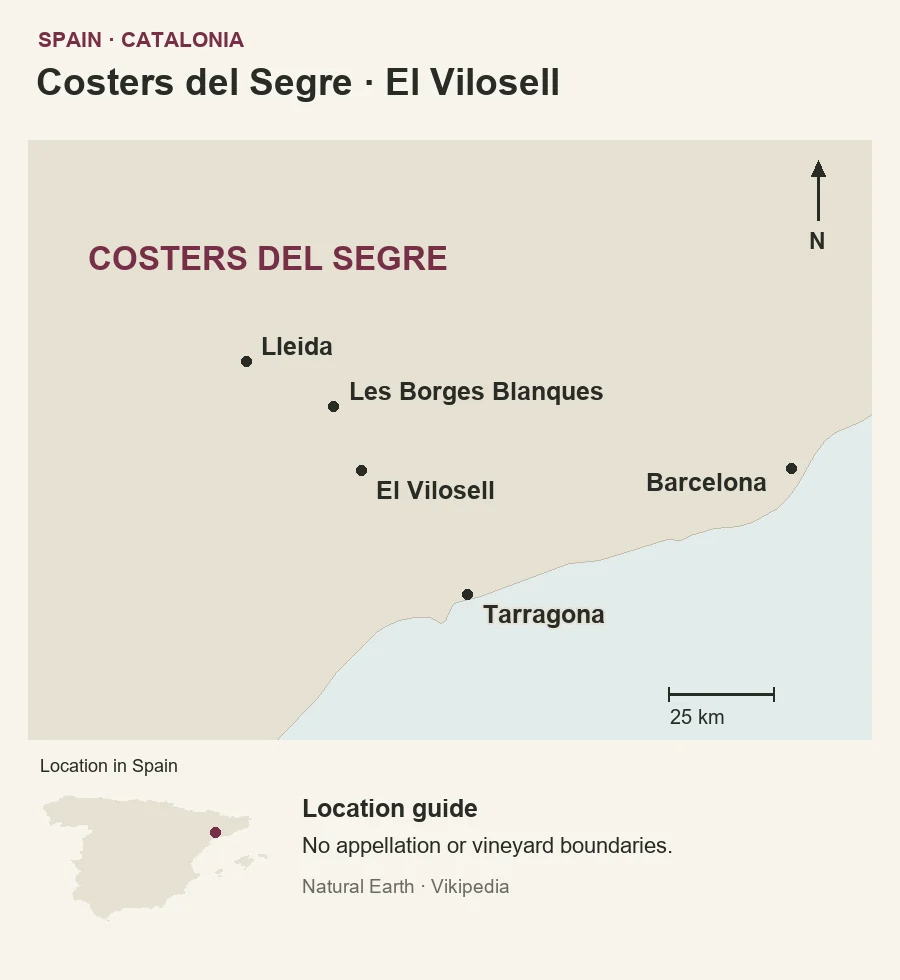
Markers show reference towns, not vineyards. Sources: Tomàs Cusiné · Natural Earth.
Fly over the area in Google Earth ↗
An aerial overview of the landscape. Zoom, rotate and tilt the camera to explore. It does not identify the specific vineyards supplying this wine. Opens in a new tab.
Seven zones, no compulsory flavour
The appellation specification distinguishes seven geographical units: Segrià, Raimat, Artesa de Segre, Urgell, Pallars, Valls del Riu Corb and Les Garrigues. These are not seven grape varieties or seven quality levels. They are zones within an appellation, distributed across a broad territory where conditions do not repeat uniformly.
This detail helps avoid a common mistake: tasting one bottle and using it to describe an entire region. A sample may awaken curiosity, but it cannot summarise every combination of soil, relief, variety and winemaking. Approaching Costers del Segre means accepting diversity from the outset. That is an advantage for curious drinkers, even if it complicates the slogans.
The appellation establishes a framework for origin and production. Growers and winemakers still make decisions within that framework. It does not prescribe one texture, one aroma or an identical maturation formula. On a wine list, the DO provides useful orientation; questions about the individual wine come next.
Inland does not mean identical
Continentality is an important reference here: an inland climate brings seasonal contrasts, and rainfall can be limited. But those words do not describe every hillside. Elevation and relief create different situations, while air movement qualifies the idea of an interior sealed off from all outside influence.
The Regulatory Council explains the appellation’s range of elevations and environments and has published discussions of mountain influences. For the reader, the practical consequence is straightforward: asking for the village or parcel adds information. “Lleida” is correct, but too broad to predict how a particular crop was grown.
We also need to distinguish climate from weather. Climate describes patterns over long periods; weather tells us what happened in a season or on a day. We cannot describe an estate’s 2025 harvest by copying a general account of its region. Precise claims about that crop require producer information or suitable records.
Zooming in: El Vilosell and La Serra
El Vilosell falls within Les Garrigues in the appellation’s geographical definition. We are near the Prades mountains, in a part of the territory that challenges the image of an endless plain. This is the geographical setting for Tomàs Cusiné’s La Serra del Vent.
The general wine sheet identifies La Serra as a 0.8-hectare parcel at 730 metres, facing northeast. It describes a steep slope and shallow soil. These details let us move from a regional map to a specific site. They do not independently establish the aromas of the 2025 vintage or automatically prove quality.
Aspect indicates how the ground is positioned relative to the sun; slope modifies that relationship. Available water, vegetation and vineyard management complete the scene. Focusing only on metres above sea level would be rather like describing a restaurant solely by its floor in the building. The information is real, but we still need to know the cooking.
Why chardonnay can tell us about a place
A variety grown in many countries does not necessarily lose its ability to express differences in cultivation. Precisely because we know diverse chardonnays, we can compare them. The grape’s name offers a common starting point; it does not require the reproduction of one international style.
In general terms, chardonnay can show different profiles according to climate and grape ripeness. It also responds noticeably to certain production decisions. It helps to separate three questions: what fruit arrived from the vineyard, what the cellar did with it and what happened later in bottle. Mixing all three encourages explanations that are too quick.
Butter is a useful example. That descriptor is not a command issued by the variety. Malolactic conversion, which transforms malic acid into lactic acid, can contribute dairy-like sensations; their presence and intensity depend on the circumstances. Contact with lees, yeast remains from fermentation, can also influence texture. These are winemaking possibilities, not practices confirmed for our 2025 bottle.
Amphora and oak: ask what they do
La Serra del Vent’s general documentation mentions both vessels. This is an opportunity to avoid another shortcut: assuming amphora automatically means “natural” and a barrel automatically means “vanilla”. A vessel is a tool. Its material, size, previous use, conditions and contact time matter to the result.
Wood may contribute aromatic compounds, but its impact is not identical in a new barrel and a used one, or at every size. Clay does not define a single way of working either: “amphora” does not tell us everything about linings, porosity or management. Vocabulary helps when it opens questions. It becomes less useful when a fashionable label replaces an explanation.
Here, the technical document linked from the product page is general and does not explicitly identify the 2025 crop. Its exact proportions and timings therefore remain to be confirmed for this vintage. The photograph and product title do establish the year. Separating confirmed information from open questions improves the profile and prevents a wine from inheriting its older sibling’s biography.
Using this information when choosing and tasting
When looking for a white, start with the style you fancy: lighter or fuller, with noticeable oak influence or with fruit in the foreground. Then ask about the specific origin and production. Knowing that the grapes come from a higher parcel provides context, but it does not replace those questions or an informed recommendation from the person serving.
In the glass, try observing acidity, texture and aromas separately. Freshness cannot be reduced to one word on a label, and a substantial wine may still have energy. Serving it excessively cold can hide differences. Allowing it to change for a few minutes lets you compare your first impression with the next, without turning dinner into an examination.
This also makes comparison more useful. Rather than asking which region is “best”, ask what changed between the glasses and which combination suits the meal or the moment. A place name becomes more memorable when it is attached to an observation you made yourself. There is no need to agree with every descriptor to learn something from the wine.
In the La Serra del Vent 2025 profile, I describe a broad, silky palate with acidity that gives it energy. The regional journey locates it within Costers del Segre without confusing that impression with an automatic explanation of origin. Next time someone says “a chardonnay from Lleida”, perhaps we can continue with “which zone?”. That is where it becomes interesting: when the map stops being decoration and helps us drink more attentively.
Sources consulted on 21 October 2026: appellation specification, 2024 document; Regulatory Council, territory and viticulture; La Serra del Vent product, titled 2025; general producer sheet. Varietal concepts checked against study references; methods unconfirmed for 2025 are presented as context.
Wine comes from somewhere
Wines from this region, glass by glass
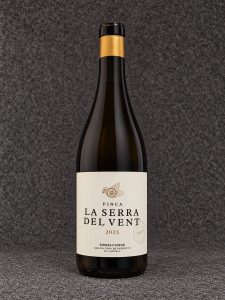
La Serra del Vent 2025: chardonnay with its own address
My tasting of Tomàs Cusiné’s white, its El Vilosell parcel and the distinction between general information and vintage facts.
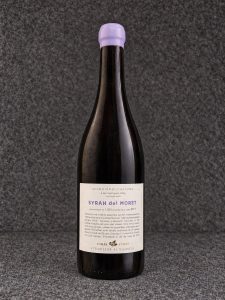
Syrah del Moret 2017: a parcel worth talking about
My tasting of a mature El Vilosell syrah, with Moret alt’s aspect, dry farming and an unusually informative label.