
Jumilla through Las Gravas: there is more to the map
20 October 2026 · Vikipedia
“Jumilla” fits on one line of a wine list. Out in the vineyard, the explanation needs more space. “Hot weather and Monastrell” is convenient shorthand, but it leaves quite a lot out. Save the comfort for the chairs.
Start with the location
The PDO covers Jumilla in Murcia and six municipalities in Albacete. This is inland country. The Wine Council describes a dry continental-Mediterranean climate, with cold winters and hot summers. An appellation defines a regulated origin; it does not promise that every wine will taste alike.
Height complicates the picture
The Council places vineyards between 320 and 1,000 metres. That range should make us cautious about a flat portrait of the region. It does not let us rank every bottle from freshest to ripest by elevation alone. Exposure, season, farming and winemaking decisions also need to enter the conversation.
On a wine list, that becomes a useful question: beyond whether a wine is “powerful”, what do we know about its particular origin? Dinner need not become an entrance exam. One good question is worth more than five adjectives in a row.
Moving closer to El Molar
Casa Castillo locates its vines on the northern slopes of the Sierra de El Molar, with limestone gravel and calcareous sands. This is one example within Jumilla, not a compulsory description of the entire appellation. Las Gravas connects a bottle to a documented site; it does not transfer its characteristics to every neighbour.
Dry farming and bush vines, plainly explained
The Council identifies dry farming and bush-vine training as predominant. One concerns reliance on rainfall; the other describes the plant’s form. Water supply and canopy organisation are different questions. Neither term is a tasting note.
The point is to understand how this landscape is farmed, rather than award an automatic medal for hardship. A demanding climate creates decisions to make; calling it “difficult” does not replace information about a particular bottle.
Monastrell: arriving late comes with conditions
The Regulatory Council describes monastrell as late-budding and very late-ripening, needing warmth to complete its cycle. Budbreak begins shoot growth; ripening takes the fruit towards harvest. Those are different stages, even when compressed into the phrase “a grape adapted to the climate”.
Needing heat does not mean tolerating any drought. Water availability and the timing of shortages still matter. A vine does not interpret “Mediterranean variety” as permission to dispense with water. Regional adaptation likewise does not prove every parcel responds identically during a difficult season.
Why look at a particular slope?
El Molar takes us beyond a generic picture of southeastern Spain. A slope has an aspect; a parcel has soil and conditions affecting water availability; a harvest has its own sequence of weather. These are questions that help structure a visit or a reading, not answers we can fill in merely because we have seen a photograph.
Avoid the reverse shortcut too: hearing “north-facing slope” and immediately promising a light wine. Aspect is one part of the picture. Ripeness at harvest and winemaking decisions also matter. If a compass settled everything, wineries could considerably shrink their laboratories.
One region, several registers
The appellation itself presents diverse wine profiles. Our starting point should therefore not be deciding whether Jumilla is “powerful” or “elegant”, as though only two boxes existed. Fruit, texture, freshness and style are useful questions without turning them into rival camps.
For Las Gravas 2021, we now have vintage-specific documentation of the blend and ageing. Its entry keeps my tasting impression separate from those facts. That is a useful exercise in understanding a region: connect a particular experience with checked information and leave room for the next wine to extend the map.
Back to the glass
Las Gravas 2021 opens this discussion through a real tasting. The floral and mineral description belongs to Hugo’s published impression. Geography supplies context, but does not prove the cause of each aroma. We can enjoy both without calling the map as a witness for the nose.
The next Jumilla bottle may offer another route: a variety, a different area or a winemaking practice. This journey is a starting point, not a template forcing every wine to tell the same story.
Sources and review
- Casa Castillo: finca y cultivo
- European Cellars: Las Gravas (descripción general, no ficha exclusiva de 2021)
- Consejo Regulador: territorio
- Consejo Regulador: viñedo
Additional documentation
Expanded and reviewed on 20 October 2026.
Wine comes from somewhere
Wines from this region, glass by glass
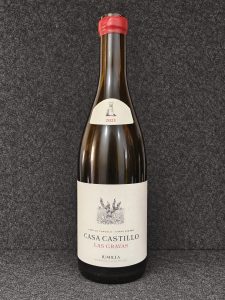
Casa Castillo · Las Gravas 2021
Monastrell and Garnacha from Jumilla: a bottle that opens a conversation about stony vineyards without asking you to taste the driveway.