
Secateurs Chenin Blanc 2017
18 October 2026 · Vikipedia
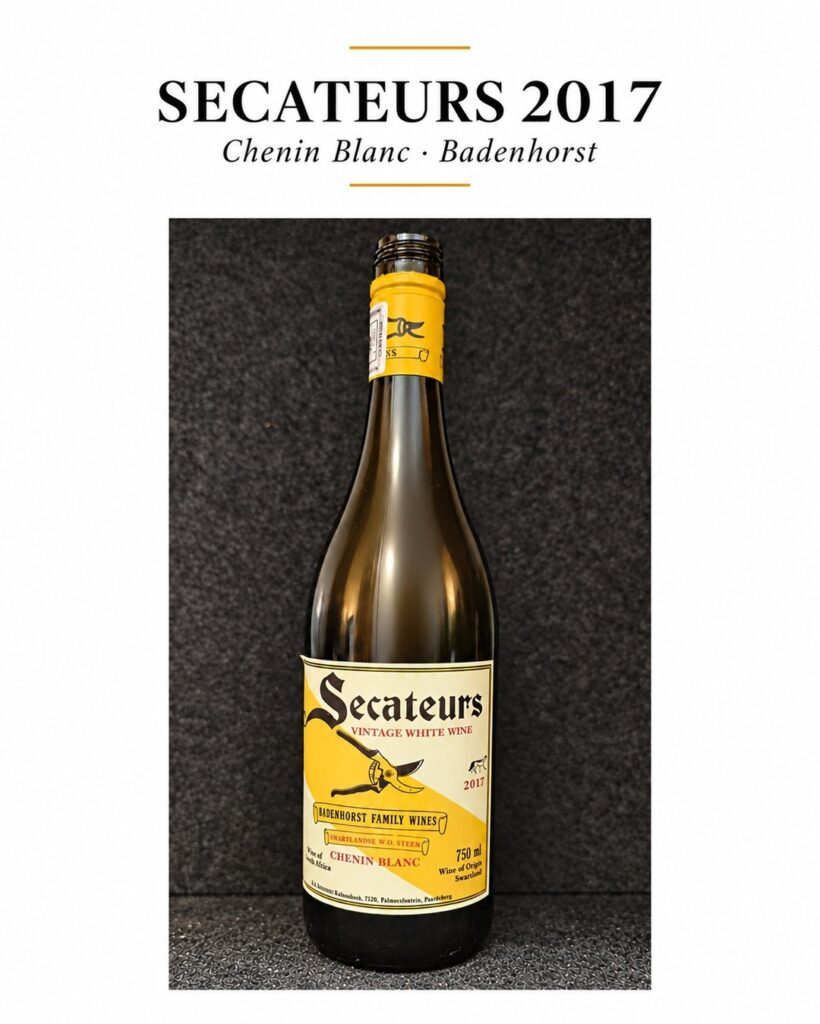
The scissors on the label have an advantage over many wine descriptions: their purpose is obvious. This white offers an equally concrete starting point: a grape, a place and what I found in the glass.
- Winery
- A. A. Badenhorst Family Wines
- Grapes
- Chenin Blanc
- Origin
- Swartland · South Africa
- Vintage
- 2017
What I found in the glass
Green apple, apricot and a touch of honey, with freshness and good concentration on the palate.
Tasting note published on Instagram on 14/10/2026 · @sommelier.vi.cat
Swartland: a landscape behind the name
We are in southwestern South Africa, north of Cape Town. Malmesbury is a useful reference point; Paardeberg is one of the hills that help organise the map. Swartland is neither one farm nor one village: naming the region starts the address, rather than bringing us to the door.
Picture cereal fields and vineyards spread across plains and slopes. Summers can be very hot. Bush vines are characteristic: low, branching plants rather than a wall of foliage trained along wires. Their canopy can shade the grapes. Even grapes appreciate a parasol when the heat arrives.
Where does this Secateurs fit?
A. A. Badenhorst’s current description places its Chenin Blanc on the northern side of Paardeberg, using old, rain-fed vines on granite soils. Rain-fed means relying on rainfall rather than irrigation. That is more specific than “South Africa”, although the page is not a technical sheet for 2017; it cannot establish the exact plots used for this vintage.
The landscape helps us ask how the grapes are grown and ripen. It does not turn granite into an aroma we are obliged to find. The freshness and concentration I described are impressions of this bottle. The map tells us where we are starting, but cannot do the tasting for us.
Chenin: freshness has more than one accent
Chenin blanc can make dry, sweet and sparkling wines. Its tools include naturally high acidity, which it can retain even in warm regions. “South Africa” is therefore not an instruction for a white wine to feel heavy. Location, grape ripeness and winemaking decisions help determine the style.
Smell and taste deserve separate attention too. A hint of honey, as I found in this bottle, does not establish that a wine contains residual sugar. Sweetness is assessed on the palate; an aroma does not arrive with a teaspoon of sugar attached. Keeping the two distinct makes tasting easier to explain without treating every word as a laboratory result.
For this Secateurs, my impressions remain freshness and concentration. The variety’s general characteristics help put those into context, but cannot replace a 2017 technical sheet: exact proportions, vineyard parcels and ageing for that vintage remain unverified here. For a wider view, follow Swartland’s dry-farmed vineyards, bush vines and diversity.
The post and the facts
Regional references
- Swartland Wine & Olive Route
- Wines of South Africa · paisaje / landscape
- Wines of South Africa · viñas / vineyards
Additional documentation
Expanded and reviewed on 20 October 2026.