
Garrigues Altes: elevation does not work alone
31 October 2026 · sommelier.vi.cat
When a wine says “740 metres”, there is always a temptation to nod solemnly. As though quality came with an altimeter and anything at 739 needed to apologise. Syrah del Moret 2017 offers something more interesting: a chance to understand what elevation, aspect and dry farming mean when we put them together in a vineyard at El Vilosell.
Costers del Segre · El Vilosell on the map
El Vilosell lies in Les Garrigues, south-east of Lleida, and provides the local reference for these Tomàs Cusiné wines. Costers del Segre covers other areas too: this close-up shows neither its full boundaries nor exact vineyard locations.
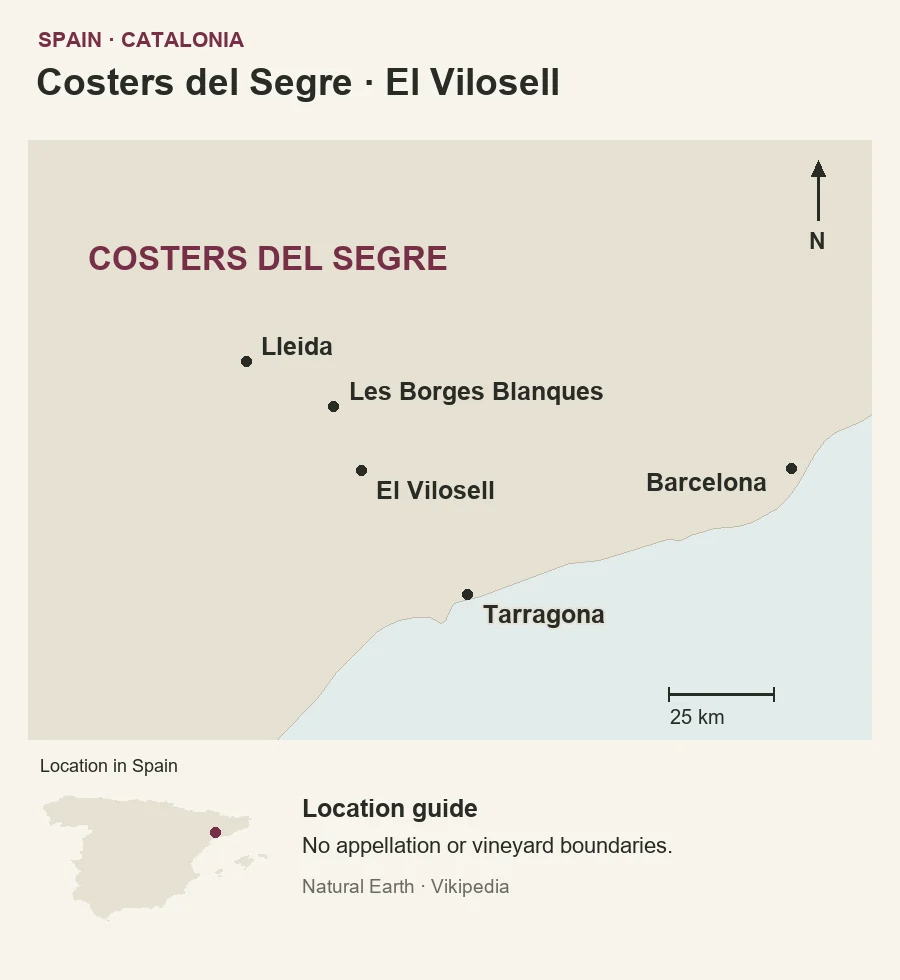
Markers show reference towns, not vineyards. Sources: Tomàs Cusiné · Natural Earth.
Fly over the area in Google Earth ↗
An aerial overview of the landscape. Zoom, rotate and tilt the camera to explore. It does not identify the specific vineyards supplying this wine. Opens in a new tab.
The Garrigues Altes within a bigger map
El Vilosell lies in Les Garrigues, inland Catalonia, near the Prades mountains. In wine terms it belongs to the Les Garrigues zone of DO Costers del Segre. The appellation brings together seven separate geographical zones. Discussing its climate as though it were a single estate therefore leaves quite a lot out.
The broad reference is continental: marked seasonal differences and an inland environment with limited rainfall. But “inland” does not mean an absence of nuance. On higher ground, relief and air movement can modify conditions. The Regulatory Council has collected producers’ accounts of the influence of breezes and mountains. These provide regional context, not a weather record for our parcel in 2017.
The wording Garrigues Altes on the label helps us move beyond an image of uniform flat land. Rather than looking for one postcard view, it is more useful to notice changes in the terrain. A winery may stand in one village while working vineyards in different situations. At Moret, the producer describes the parcel, so we can move closer without guessing.
What a useful label can tell us
sommelier.vi.cat’s bottle identifies Moret alt: a 1.35-hectare terrace planted in 2005, facing northwest at 740 metres. Those details also appear in Tomàs Cusiné’s documentation. They are specific pieces of information: area, planting date, exposure and altitude. None tells us on its own how the wine tastes.
A small parcel allows a clearly defined origin to be described. It does not automatically make the wine superior. Nor does a planting date entitle us to call something “old vines” simply because we feel enthusiastic. Twelve years had passed between 2005 and the 2017 harvest. Precision has an advantage: it stops adjectives taking the place of information.
Microvinification means winemaking on a small scale. Here the label declares 1,323 bottles. The number describes the size of the lot, not a score, its current market rarity or a guarantee of excitement. Any excitement still has to be found when we taste it. The number cannot do all the work.
Elevation does not work alone
Altitude can contribute to cooler conditions compared with nearby lower sites, but the comparison makes sense only when other factors are considered. Latitude, aspect, air circulation and the shape of the land matter too. Two vineyards at the same elevation may receive different amounts of sunshine or accumulate cold air differently.
Moret alt’s northwest aspect is especially worth noticing. It identifies the direction the land faces, not the exact number of hours each bunch spent in sunlight. On a hillside, slope changes the angle of incoming radiation; leaf distribution also modifies fruit exposure. For an everyday explanation, remember this: living on the same floor does not mean having the same window.
It is therefore not rigorous to promise a particular acidity or ripeness solely from the altitude. Studying how the site may influence ripening is reasonable. After that we need harvest information and the glass itself. Geography guides tasting; it does not replace it, or have the right to correct what you actually perceive.
Dry farming: water cannot be negotiated with a label
The vineyard is described as dry-farmed, relying on available rainfall rather than routine irrigation. That directs attention to when water arrives, how much the soil can store and how the plant uses it. Even an annual rainfall figure, if we had one, would not explain the whole growing cycle.
Moret’s information distinguishes a poor gravelly surface from clay beneath it. In general, texture, depth and structure influence drainage and water retention. Not all clay behaves identically, and stones at the surface do not mean there are no reserves below. Reading the soil profile is more useful than choosing its most photogenic component.
We should also resist turning water stress into a medal. Limited availability can modify growth, but severe shortage compromises vine function. The growing objective cannot usefully be reduced to “make it suffer”. Plants do not produce better wine because they have read an inspirational survival story.
A syrah that does not need a French passport
Syrah and shiraz are two names for the same grape. Understanding its classic reference points helps us study styles, but a syrah from El Vilosell is best understood first through its own origin and production. Sharing a variety does not make it a copy of the Rhône, any more than sharing a surname requires the same personality.
Wine education describes general differences between expressions from moderate and warm climates: fruit ripeness, body and other characteristics can change. These are models that help us observe. They do not prove that this particular bottle smells of pepper, has a given tannin level or is currently at its best.
Passing years add another variable. Storage, closure and the development of each bottle affect what reaches the glass. The year 2017 does not establish an expiry date or an exact drinking window. My impression of this Moret is mature, silky and fresh. It is developed in the wine profile and remains separate from the technical explanation.
From grapes to bottle: time has layers too
The label dates harvesting to 28 September 2017 and bottling to 28 May 2019. Between those events it records 23 days in vat with the solids and eleven months in five French oak barrels. In red winemaking, the period with skins and other solids forms part of the decisions governing extraction.
These timings are not synonyms. Fermenting, remaining in contact with skins, maturing and bottling describe different processes. Nor should unexplained intervals be filled with imagined techniques. Where a source supplies partial dates, keeping them partial is the honest approach. We know enough to understand the journey without inventing the rest of the calendar.
Back at the wine list, the origin now says a little more: El Vilosell, a northwest-facing terrace, dry farming and a particular harvest. Elevation still matters, but now it has company. That gives us a better conversation than simply pronouncing “seven hundred and forty” as though we had just revealed the winery’s secret password.
Sources consulted on 21 October 2026: sommelier.vi.cat’s label photograph; Tomàs Cusiné, Syrah del Moret; Costers del Segre specification, 2024 document; Regulatory Council, mountains and viticulture, 22 December 2020. Varietal context checked against study references.
Wine comes from somewhere
Wines from this region, glass by glass
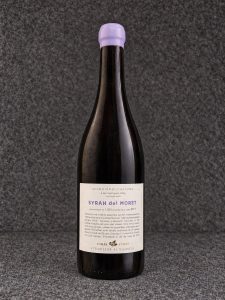
Syrah del Moret 2017: a parcel worth talking about
My tasting of a mature El Vilosell syrah, with Moret alt’s aspect, dry farming and an unusually informative label.